
Anchorsholme Coast Protection Scheme begins the early stages in 2026, with site works for a vital sea defence project now underway. Work to construct the compound began on 26 January 2026.
Anchorsholme Coast Protection Scheme 2026
The scheme will protect over 5,000 properties from flooding and help save the sandy beach from coastal erosion, ensuring that homes and businesses remain safeguarded for years to come.
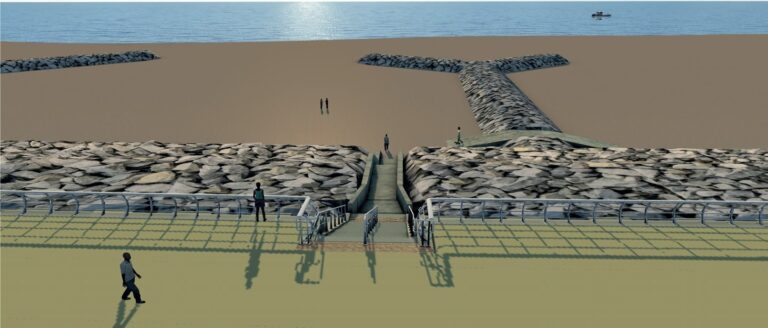
Five rock groynes are to be constructed on Anchorsholme beach. Plus a rock revetment installed on top of the existing sloped seawall. The rock revetment will strengthen and stabilise the seawall, with the rocks helping to reduce wave force during storms.
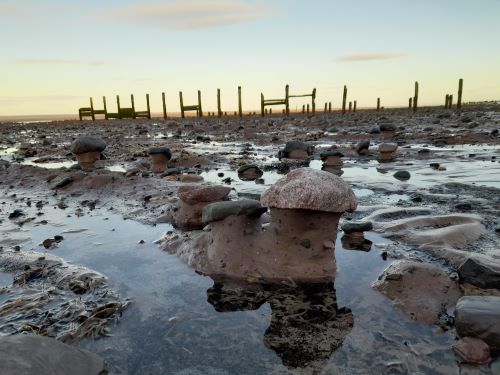
The rock groynes will help address the ongoing lowering of sand levels on the beach (below). At times, this has led to the underlying clay becoming exposed. Once this erodes, the beach is lost forever. The groynes will trap sand and raise beach levels, absorbing wave energy and reducing the risk of flooding.
The Environment Agency is fully funding the £11 million construction of the rock groynes. The cost of the rock revetment is being covered by contractors Balfour Beatty to address issues from previous coastal defence works.
With the compound complete, work on the beach and revetment began in May 2026.
Preserving the Beach
Cllr Jane Hugo, Blackpool Council Cabinet Member for Climate Change, said:
FREE Newsletter
FREE Newsletter

“This scheme is vital for protecting the community from flooding and for preserving the beach at Anchorsholme for future generations. With the climate change emergency, rising sea levels and reduced sand levels are inevitable unless we do something. If we do nothing, then the risks of sea water flooding properties are higher, which is simply not an option for this council.”
Delivering Anchorsholme Coast Protection Works
How it Works
With construction of the compound complete and systems in place, work at Anchorsholme will settle into a steady rhythm.
The big red Armstrongs trucks will arrive at site, loaded with their huge rocks. They’re granite, coming from the quarry at Shap in Cumbria, and weigh in at a whopping 6-10 tonnes per piece. After arriving at site and checking in at the gate, trucks follow the circular road in the handling area. The rocks are unloaded and the empty truck leaves the site, returning some time later with another load!
Each rock is marked with its weight before being loaded onto one of the big, yellow Tonka trucks. These huge vehicles easily manoeuvre the pieces out of the storage yard and down to the beach. There’s only space for a couple of days rock deliveries in the compound, so some are stored on the beach. If you see odd rocks in seemingly strange places, this is why! Others are used straight away. The blue tracked-excavators carefully position them according to the design. Each individual rock is GPS located by the tech in the cab of the excavator. The location and position of every stone is recorded in as-built drawings. They’re a permanent record of the construction.
Obviously work on the beach is tidal – some weeks are productive and others aren’t. Working hours are 7am-7pm.
Managing Disruption
‘You can’t make an omelette without breaking an egg‘. While these works are vital to protecting the shoreline, it undoubtedly causes some disruption in the area. However all steps are taken to minimise the effect on the environment and people who live in and use the area.
For example, the contractors continually monitor vibrations that could cause disruption to local residents. Specialist monitoring equipment is placed on or near the working area to detect small vibrations. These are continuously measured and recorded. Recorded vibration levels are compared against recognised safe limits. If vibrations exceed these limits, the monitoring equipment will trigger an alert to the site team. Works will then be paused while the cause is investigated.
If you have concerns about vibrations near the works, please contact:
- Balfour Beatty (contractor): chris.leach@balfourbeatty.com
- Blackpool Council Customer First: 01253 477477
2026: Beach Access
Heading to the beach at Anchorsholme? Please be aware that access steps from the promenade to the beach are closed while the works take place.
The beach between Little Bispham tram stop and Kingsway remains open, with small areas cordoned off at the start of each working day. While work is taking place, marshals are on the beach to advise the public.
Two sets of steps can be used to exit the beach if needed:
✦ Steps 3 – opposite the tennis courts at Anchorsholme Park 🎾
✦ Steps 6 – opposite Chatteris Place/the end of Anchorsholme Lane West 🏘️
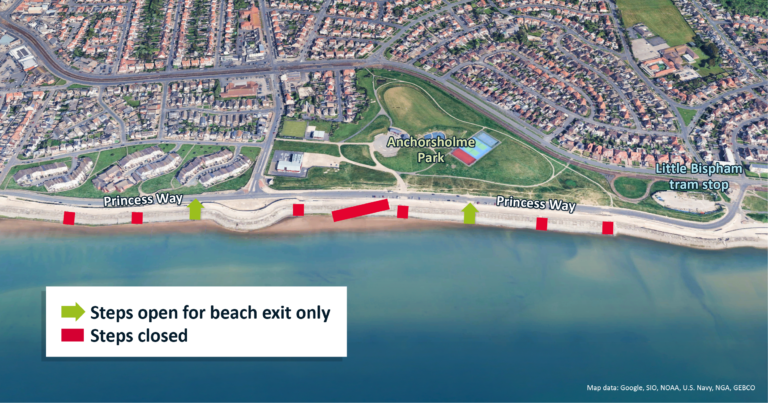
Remember to follow beach safety signage, check tide times and give yourself plenty of time to get back up the beach and onto the prom as the tide comes in.
To find out more, visit: www.blackpool.gov.uk/Anchorsholme
You can sign up for WhatsApp updates from Blackpool Council here
2026: Work starts on the beach at Anchorsholme Coast Protection Scheme
The main works for a coastal protection project in Blackpool began on Tuesday 5 May 2026.
With construction of the compound almost complete, works to the sloped revetment have now started. Along a section stretching from Little Bispham tram stop to Kingsway, rock armour is being added to stabilise the existing structure and provide additional protection. These works are due to finish in May 2027.
Contractors will then begin the construction of five rock groynes on the beach. These will help prevent coastal erosion and protect nearby properties from flooding. Groyne works are due to be completed in early 2028.
Rock groynes are safely used in the UK and internationally. They help tackle the problem of coastal erosion and are proven to be an effective solution. They trap and retain sand on the beach and can also support local biodiversity by creating new habitats. It’s just one part of work being done to protect homes and preserve Blackpool’s sandy beaches for future generations.
Works are being carried out by contractors Balfour Beatty, with funding for the rock groynes allocated by the Environment Agency. The beach and promenade will remain open during the works and marshals will be on the ground to assist with safety.
2026: Setting up the Compound
Adjacent to Little Bispham tram stop, the existing compound is now site offices, parking, contractors vehicles and storage. An additional compound (below), built across the junction on the grassy seafront area, is the good inwards/handling area for rock deliveries. It includes a turning circle where the lorries arrive, their cargo of stones is offloaded, then they drive out of the site. A new haul road to the beach allows access for heavy equipment.
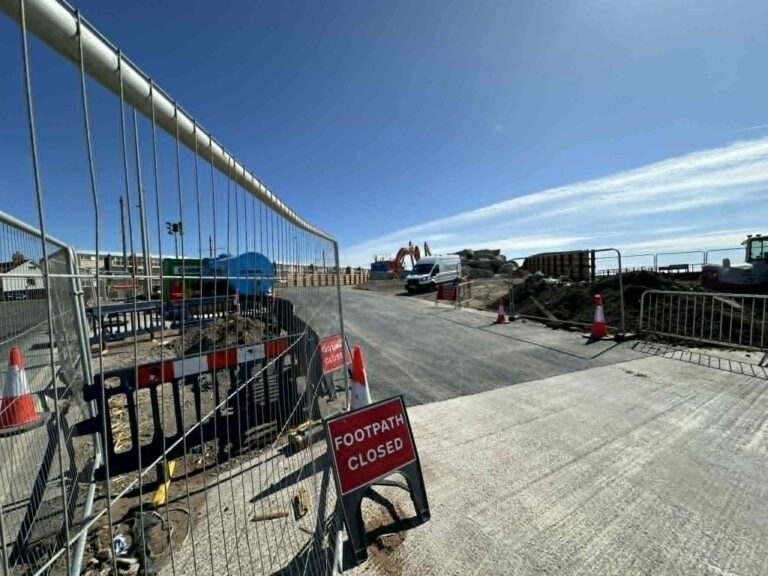
The project team has worked with the local community to develop a design for the hoardings facing people’s properties. Blackpool Council understands that the works will cause some inconvenience to nearby residents. However, if this work does not happen, the community is at direct risk from coastal flooding.
To enable access and utility works, Princes Way was closed from 27 January to 28 February 2026 at the junction with Queen’s Promenade. The rest of Princes Way remained open at Kingsway and Anchorsholme Lane West, with a signed diversion in place. Pedestrian access remained open. A section of Cycle Route 62 will close periodically, with diversions provided.
While you’re here…
Go to the homepage of the Live Blackpool website for the latest updates.
Love the Fylde Coast? Sign up for your email newsletter. Packed full of interesting things it arrives in your inbox all 52 weeks of the year.
👉Join us on Facebook at our Visit Fylde Coast Facebook Group. Plus hundreds of videos to watch on our YouTube channel – from all over the Fylde Coast!
📣JOIN our new VFC WhatsApp Channel for what’s happening, interesting local information, history, communities, events and much more.
Booking a stay? Pick a safe, clean and legal place to stay, at the very best price. Book with the Visit Fylde Coast guide.

We Need Your Help
We Need Your Help